Soir Records
1. The Burning Palo Santo and the Dom Pérignon Magnum: Anatomy of a Modern Paradox
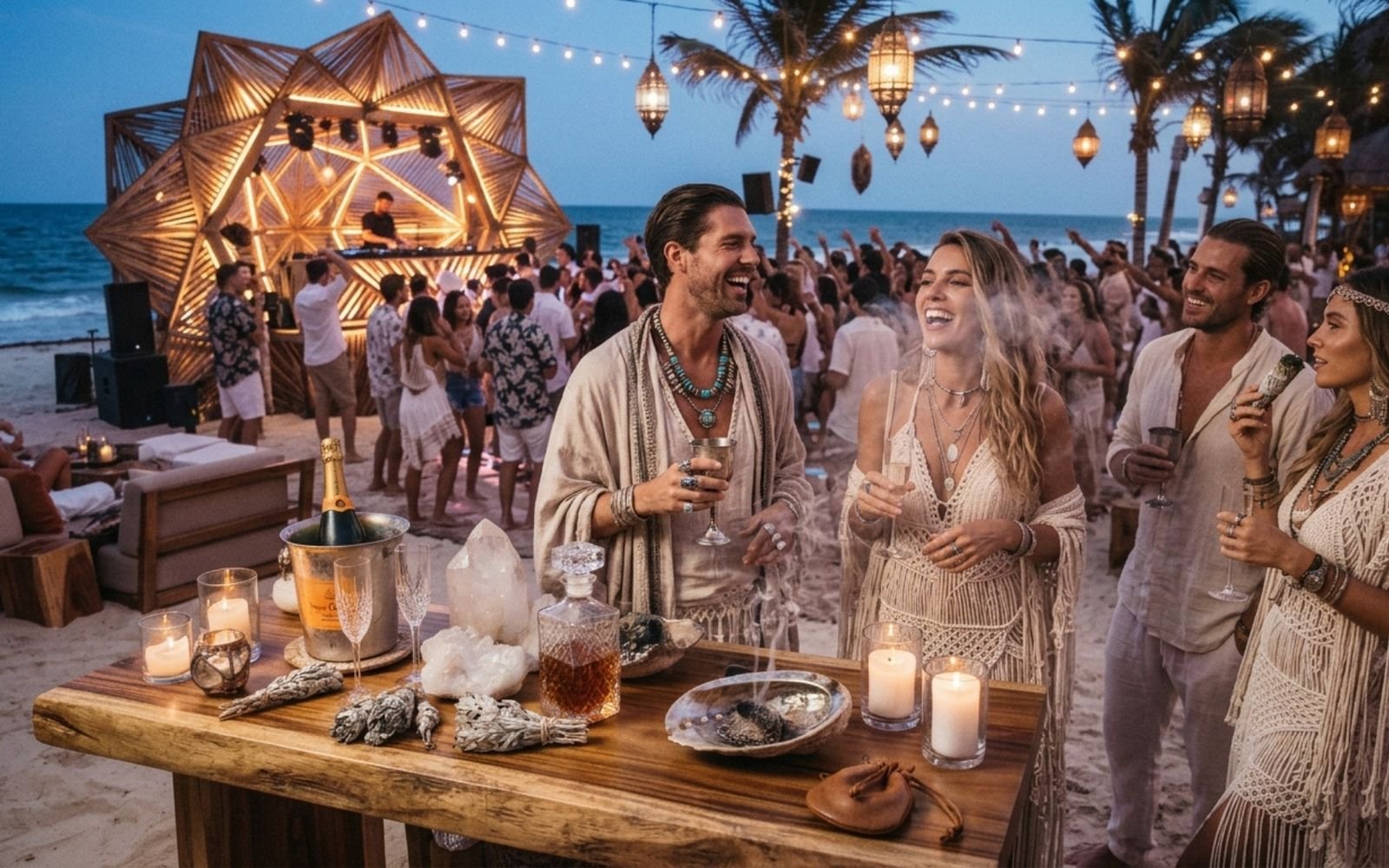
Stand on the sun-baked, terraced cliffs of Paraga Beach in Mykonos at 7:15 PM in mid-July. The Aegean sun hangs two finger-widths above the horizon, bathing the stone amphitheater of Scorpios Mykonos in a warm, amber wash. The air is thick with the resinous, sacred scent of burning Palo Santo and copal smoke drifting from clay braziers placed along the perimeter of the DJ booth.
On the wooden dancefloor below, three hundred bodies move in collective, undulating synchronization. Barefoot on woven sisal mats or sinking into powdery sand, the crowd presents an uncanny tableau of desert nomadism: raw, unbleached cotton kaftans, fraying earth-toned linen tunics, hand-strung yak bone amulets, wide-brim distressed felt hats, and feathered talismans. There is no strobe lighting. There are no CO2 cannons. There are no video walls blasting corporate sponsor logos. To an uninitiated observer, this appears to be an ancient, egalitarian tribal ritual—a gathering of spiritual ascetics assembled on a Mediterranean cliffside to venerate the setting sun through rhythm and collective trance.
Then, turn your gaze five meters to the right.
Behind a low barrier of hand-stacked drywall and sun-bleached driftwood, a dedicated enclave of private cabanas sits elevated above the sand. Here, ice buckets sculpted from raw basalt hold triple-magnum Methuselahs of Dom Pérignon and luminous bottles of Clase Azul Ultra tequila. Private security personnel in discreet, collarless linen shirts quietly guard velvet rope stanchions wrapped in nautical hemp. On the polished wooden credenza of a single VIP table, a card machine registers a €15,000 minimum spend commitment—a figure that will easily double by midnight once the caviar platters, vintage mezcal flights, and service gratuities are tallied. Offshore, anchored in the turquoise bay, fifty-meter superyachts sway gently on their moorings, their tenders ferrying tech founders, venture capitalists, fashion royalty, and sovereign wealth heirs directly onto the private jetty.
Welcome to the defining sociological spectacle of modern nightlife: "Shamanic Capitalism" and the Boho-Luxury Dancefloor.
Over the past decade, spanning from the white-sand cenotes of Tulum to the wind-swept bluffs of Mykonos, the pine-crested shores of Ibiza, and the secluded peninsulas of Bodrum, high-end electronic music culture has undergone a profound aesthetic mutation. The garish, neon-drenched, Champagne-spraying bottle service culture that defined 2010s Las Vegas and Miami has been comprehensively dismantled. In its place stands an ultra-lucrative lifestyle ecosystem where spiritual asceticism is the ultimate luxury flex, where the uniform of poverty is recoded as stealth wealth, and where Afro House and Organic House serve as the sonic currency of the global billionaire class.
2. The Death of Vegas Ostentation: How "Quiet Luxury" Conquered the Global Dancefloor
To understand how spiritual bohemianism became the dominant aesthetic of high-roller nightlife, one must examine the total exhaustion of the model that preceded it.
THE EVOLUTION OF HIGH-END NIGHTLIFE CONSUMPTION (2012 vs. 2026)

[2012: The Vegas / Miami Hyper-Ostentatious Model]
   • Aesthetic: High-gloss black acrylic, chrome stanchions, LED video ceilings, neon lasers
   • Signifiers: Dom Pérignon sparkler trains, oversized cardboard checks, waitresses in corsets
   • Wardrobe: Loud designer logos (Gucci, Philipp Plein), bandage dresses, Christian Louboutin stilettos
   • Sonic Profile: 128–130 BPM Big Room EDM, aggressive sawtooth drops, loud festival risers
   • Sociological Motivation: Conspicuous Consumption (Displaying raw financial power through volume)

                                  │
                                  ▼
[2026: The Boho-Luxury / Shamanic Chic Ecosystem]
   • Aesthetic: Unpolished tadelakt, driftwood, raw stone, desert cacti, open-air amphitheatres
   • Signifiers: Burning Palo Santo, cacao ceremonies, woven sisal rugs, basalt ice vessels
   • Wardrobe: $1,200 raw linen kaftans, $1,500 Nick Fouquet distressed hats, barefoot luxury
   • Sonic Profile: 118–122 BPM Afro & Organic House, live percussion, acoustic instruments, warm low-end
   • Sociological Motivation: Conspicuous Spiritual Capital (Displaying enlightenment, wellness & stealth wealth)
The Exhaustion of the Sparkler Train
Between 2010 and 2016, the peak of electronic dance music commercialization was typified by mega-clubs like XS, Hakkasan, and Marquee in Las Vegas, or LIV and Story in Miami. In these subterranean, hyper-compressed environments, status was conveyed through pure, unadulterated sensory violence. Wealth was announced via "sparkler parades": ten cocktail waitresses in matching latex swimwear carrying illuminated letters spelling out a guest's name, accompanied by sirens and fireworks strapped to $2,000 bottles of lukewarm champagne.
By the late 2010s, this visual grammar had become an object of cultural parody. The sociologist Thorstein Veblen, in his foundational 1899 treatise The Theory of the Leisure Class, posited that the elite continuously invent new forms of "conspicuous consumption" to distinguish themselves from the classes below them. The moment a status symbol becomes accessible to the mass affluent—when suburban bachelor parties could pool funds to buy a low-tier table with sparklers—the ultra-wealthy immediately abandoned it.
Loud ostentation began to read as "nouveau riche," vulgar, and desperate. The cultural elite did not want to be seen standing beneath a neon LED ceiling being sprayed with cheap sparkling wine. They demanded an experience that felt organic, curated, authentic, and morally elevated.
Pierre Bourdieu and the Rise of Spiritual Capital
French sociologist Pierre Bourdieu demonstrated in Distinction: A Social Critique of the Judgement of Taste that social dominance is maintained not merely through economic capital (how much money you possess), but through cultural capital (your knowledge, aesthetic refinement, and mastery of exclusive cultural codes).
In the post-pandemic era, the ultimate iteration of cultural capital is "Spiritual and Wellness Capital." In an overworked, hyper-digitalized world, the rarest commodities are not gold watches or sports cars; they are mindfulness, somatic grounding, pristine nature, emotional connection, and temporal freedom.
The boho-luxury beach club masterfully commodifies these exact desires. By clothing high-stakes commerce in the visual and sensory trappings of ancient spirituality—Palo Santo ceremonies, sound baths, yoga pavilions, raw architectural textures, and ancestral percussion—venues like Scorpios and Papaya Playa Project allow the ultra-wealthy to consume luxury while feeling spiritually immune to the guilt of materialism. You are not "partying in a nightclub"; you are "participating in a sunset communion." You are not buying a $15,000 table; you are "supporting the temple."
3. The Holy Trinity of Destinations: Scorpios, Alemagou, Papaya Playa & Zamna
The physical geography of Boho-Luxury is anchored across a tight global migratory circuit. The same demographic that spends July and August between Mykonos and Ibiza migrates to Tulum and St. Barths in January, Dubai in March, and Bodrum in June. Within this circuit, four venues have written the operating manual for the movement.
Scorpios Mykonos & Scorpios Bodrum: The Temples of Sunset Rituals
Founded in 2015 by German entrepreneurs Thomas Heyne and Mario Hertel on a barren windswept ridge at Paraga Beach, Scorpios completely reimagined Mediterranean beach hospitality. Rather than competing with the champagne-spraying hedonism of Nammos or the crowded sands of Super Paradise, Heyne and Hertel drew inspiration from holistic communal living and the radical architecture of the Greek agora.
Partnering with design studio Annabell Kutucu and architect K-Studio, they constructed a sprawling compound of raw stone walls, shaded timber pergolas, and low-slung daybeds that looked as though it had been excavated from ancient soil. When Soho House & Co (now part of the Ennismore ecosystem) acquired a majority stake in Scorpios, they recognized that Heyne and Hertel had created a global hospitality blueprint.
In June 2024, the brand expanded with the grand opening of Scorpios Bodrum on Turkey’s Bodrum peninsula. Featuring dedicated ritual spaces, private bungalows, and holistic sound healing temples alongside its signature open-air performance terraces, Scorpios Bodrum cemented the eastern Mediterranean as a primary pillar of the boho-luxury circuit.
Central to the Scorpios experience is the "Music Ritual." Every Sunday, Tuesday, and Thursday, international selectors like Bedouin, Valeron, Keinemusik, and Black Coffee helm marathon sunset sessions. The music does not start with a bang; it begins at 5:00 PM with ambient acoustic improvisation—live Mediterranean lutes, ney flutes, and hand percussion—gradually building in tempo as the sun touches the sea, before culminating in deep, percussive Afro House beneath the Aegean stars.
Alemagou Mykonos: The Wind-Swept Wabi-Sabi Sanctuary
Tucked into the northern inlet of Ftelia Beach, Alemagou presents the bohemian ethos in its purest architectural form. Designed with natural reeds hanging from thatched canopies that whistle in the Cycladic Meltemi wind, Alemagou rejects the polished sheen of conventional VIP venues in favor of authentic wabi-sabi aesthetics: unvarnished wood, sun-cracked pottery, and raw canvas.
During its sunset showcases, Alemagou operates with a raw, primal energy. While table bookings for peak events carry steep bottle commitments (with premium tequila and vintage champagne commanding hundreds to thousands of euros per bottle), the atmosphere remains deliberately tactile. Guests dance barefoot in the sand inches away from the selector, embodying the illusion of an intimate, off-grid beach party while surrounded by global private equity titans.
Papaya Playa Project & Zamna Tulum: The Jungle Temples of the Riviera Maya
If Mykonos represents the stone and sea of boho-luxury, Tulum is its lush, untamed jungle sanctuary.
- Papaya Playa Project (PPP): Founded by Emilio Heredia in partnership with Design Hotels, PPP pioneered the barefoot luxury ethos on the Caribbean coast. Famous for its iconic Saturday night gatherings and monthly Full Moon parties, PPP embeds its dancefloor within natural palm groves overlooking the ocean. Here, Mayan copal blessings and conscious mixology precede electronic sets that glide between organic downtempo and driving Afro-Latin rhythms.
- Zamna Tulum: Located inland around an open-air natural cenote, Zamna Festival represents the stadium-scale zenith of the movement. During the peak December-January winter season, Zamna transforms its 11-hectare jungle amphitheater into electronic music's most prestigious winter residency.
While general admission tickets allow thousands of spiritual seekers to dance around the water, the economic engine of Zamna is driven by its multi-tiered VIP decks and onstage cabanas. For marquee showcases hosted by collectives like Afterlife, Keinemusik, or Circoloco, prime backstage tables routinely command $15,000 to upwards of $40,000 USD in minimum spends. Guests sip mezcal from hand-blown copitas, enveloped by ancient jungle canopy, while lasers slice through the tropical mist.
| Destination & Venue | Geographic Setting | Architectural Philosophy | Signature Sonic Identity | VIP Table Spend Range |
|---|---|---|---|---|
| Scorpios (Mykonos, Greece) | Paraga coastal bluff, Aegean Sea | Greek agora, whitewashed stone, hand-woven textiles | Downtempo organic sunset transitioning into hypnotic Afro House | €2,000 – €15,000+ (Event & tier dependent) |
| Scorpios (Bodrum, Türkiye) | Secluded peninsula cove, Aegean coast | Tadelakt plaster, private ritual pavilions, olive groves | Anatolian organic melodies, deep tribal percussions | €2,500 – €20,000+ |
| Alemagou (Mykonos, Greece) | Ftelia bay, windswept sand dunes | Thatch reeds, raw timber, weathered wabi-sabi textures | Driving melodic house, deep ethnic grooves, unhurried swing | €1,500 – €8,000+ |
| Papaya Playa Project (Tulum) | Coastal jungle beachfront, Riviera Maya | Mayan wood craft, thatched palapas, open oceanfront | Organic House, Mayan tribal percussion, emotive vocal chants | $1,000 – $6,000+ (Full Moon / Peak dates) |
| Zamna (Tulum, Mexico) | Inland cenote amphitheatre, deep jungle | Immersive natural terrain, wood decking, minimal staging | Melodic Techno, Afro House, atmospheric hypnotic loops | $5,000 – $40,000+ (Peak winter showcases) |
4. The Uniform of Shamanic Chic: Deconstructing the $3,000 "Pauper's" Wardrobe
To step onto the dancefloor at Scorpios or Papaya Playa wearing a logo-plastered Balenciaga hoodie, designer sneakers, or a glittery cocktail dress is to commit immediate social suicide. The boho-luxury ecosystem enforces a dress code as strict as any black-tie gala, yet its aesthetic vocabulary is inverted: it is the art of spending several thousand dollars to look like an enlightened desert wanderer.
The Codes of "Stealth Nomadism"
The fashion of the shamanic dancefloor relies on hyper-specific textile signifiers that denote wealth through texture rather than branding: 1. Raw, Unbleached Fibers: Garments are cut from open-weave organic linen, homespun cotton gauze, and raw hemp. The palette is strictly mineral and vegetal: chalk white, desert bone, desert sand, raw taupe, charcoal, and terracotta. Shiny synthetic fabrics are entirely banned by collective social consensus. 2. Artisanal Deconstruction: Hemlines are rarely hemmed; they are frayed (desflecado), distressed, and hand-finished. Kaftans, asymmetric ponchos, and kimonos feature hand-braided leather toggles and open-weave macramé detailing. 3. The Distressed Felt Hat: Pioneered in luxury circles by milliners like Nick Fouquet, the wide-brim felt or toquilla straw hat is the crown of the boho-luxury jet-set. Priced between $1,200 and $2,500, these hats are treated with fire, wire brushes, and vintage paint to look as though they have weathered three decades of Sahara sandstorms, often accessorized with a single burnt matchstick, porcupine quill, or antique silver talisman tucked into the band. 4. Artisanal Nomadic Labels: The wardrobe is sourced from niche luxury houses that cater exclusively to this global circuit: * CARAVANA: Born in Valladolid and Tulum, crafting fluid organic cotton wraps and hand-dyed fringed kaftans utilizing ancestral Mayan leather-braiding techniques. * Alanui: Renowned for its oversized, fringe-trimmed jacquard knit cardigans crafted from precious cashmere, commanding upwards of $2,500 to $4,000 per piece. * Loro Piana & Brunello Cucinelli: The quiet-luxury titans whose unbranded, featherweight linen shirts and silk-linen drawstring trousers form the foundational base layer for tech executives dancing in Mykonos. 5. Barefoot Luxury & Tribal Adornment: Footwear is either nonexistent—dancing directly on the sand or sisal rugs—or takes the form of handmade leather huaraches and minimal wrap sandals. Jewelry avoids diamonds and polished gold; instead, patrons wear raw turquoise, polished bone beads, fossilized wood, and oxidised silver amulets sourced from Bali or Oaxaca.
The Sociological Subtext of Faux-Asceticism
Why do individuals who control colossal financial fortunes choose to dress like monastics, pilgrims, and desert nomads?
Sociologically, this is an act of "conspicuous asceticism." In a capitalist society where almost anyone can finance an entry-level designer handbag or buy a synthetic designer t-shirt on credit, adopting the aesthetic of extreme simplicity is the ultimate status marker. It sends a subconscious signal: "I am so secure in my financial and social standing that I have no need to display commercial trademarks. I have transcended materialism; I value the earth, the spirit, and the handmade."
The irony, of course, is that achieving this look of casual, effortless poverty requires thousands of dollars in disposable income, international bespoke shopping, and the leisure time to spend months lounging in resort towns.
5. Acoustic Architecture: The Physics of Sound in Open-Air Coastal Environments
The aesthetic transition from dark nightclubs to sun-drenched coastal bluffs was not merely a visual shift—it demanded a complete revolution in acoustic engineering and sound reinforcement.
Building a world-class sound system inside a subterranean concrete club (like Berghain in Berlin or Fabric in London) is an exercise in boundary management: controlling standing waves, room modes, and reflective surfaces. But when you move the dancefloor to an open-air cliffside in Mykonos or a tropical beach in Tulum, the laws of acoustics change radically.
ACOUSTIC BEHAVIOR: ENCLOSED CONCRETE CLUB vs. OPEN-AIR COASTAL BEACH CLUB

[Enclosed Concrete Warehouse]
   ┌──────────────────────────────────────────────┐
   │ ◄─── Wave Reflections & Room Modes ───►      │
   │                                              │
   │  [Sub] ───►  Boundary Reinforcement (+6-12dB)│
   │              Trapped Low-End Pressure        │
   │                                              │
   │  Air: Stable Temperature & Controlled Humidity│
   └──────────────────────────────────────────────┘
   Result: High acoustic efficiency; danger of muddy mid-bass resonance.

[Open-Air Coastal Sanctuary (Scorpios / PPP)]
        ▲  Sub-bass escapes infinitely into open sky
        │
   ~ ~ ~ ~ ~ ~ ~ ~ ~ ~ ~ ~ ~ ~ ~ ~ ~ ~ ~ ~ ~ ~ ~ ~ (Open Air Boundary)

     [Cardioid Sub Array] ──► Direct forward throw to dancefloor
                              ZERO boundary loading (Low-end dissipates)

   ◄─ Aegean Wind Shear (Meltemi) ─► Disperses Highs (4 kHz–12 kHz)

   =============================================== (Sisal Rugs / Sand / Wood)
   Result: Requires double the sub displacement; brittle highs get destroyed by wind.
1. The Disappearing Low-End: Absence of Boundary Reinforcement
In an enclosed club, physical walls and ceilings provide boundary loading (room gain). Low-frequency waves bounce off rigid concrete boundaries, reinforcing the sub-bass energy and creating physical chest pressure with relatively modest amplifier power.
In an open-air coastal environment, boundary loading is virtually zero. Sub-bass waves radiate outward into the open sky and over the sea, decaying according to the inverse-square law without any surface reflection to reinforce them. To create that deep, physical, stomach-rumbling sub-bass necessary for Afro House without distorting the sound, venues must deploy massive, ultra-efficient cardioid subwoofer arrays (such as d&b audiotechnik SL-Series or L-Acoustics KS28).
Cardioid arrays use destructive phase cancellation behind the subwoofer cabinets to focus low-end energy exclusively onto the dancefloor while preventing bass spill into the dining terraces, private cabanas, and neighboring bays.
2. The Atmospheric Destroyer: Wind Shear and Thermal Gradients
In Mykonos, the northern Meltemi winds frequently gust between 25 and 45 knots across the terraces of Scorpios and Alemagou. In acoustic physics, wind does not blow sound waves away, but wind shear (the difference in wind speed at ground level versus higher elevations) dramatically refracts sound waves.
High frequencies (specifically from 4 kHz to 12 kHz) have extremely short wavelengths that are easily scattered, refracted, and attenuated by turbulent air and fluctuating thermal gradients rising off sun-baked sand. If a DJ plays a track featuring razor-sharp, abrasive festival sawtooth leads or harsh white noise sweeps, the wind tears the phase coherence apart, transforming the music into an ear-piercing, brittle hiss.
3. Natural Material Absorption
Boho-luxury venues are constructed almost entirely from acoustically absorbent, organic materials: weathered wood decking, loose sand, hand-woven sisal floor coverings, and thatched palm fronds. These materials possess high absorption coefficients in the upper-mid frequencies, effectively deadening harsh flutter echoes.
Consequently, the physical architecture naturally demands music built around warm, rounded transients, organic percussive timbres, and rich sub-bass, while physically rejecting aggressive digital distortion.
6. The Sonic Code: Why Afro House & Organic House Became the Currency of Elite Hospitality
When club designers swapped concrete and neon for cedar wood, lime plaster, and desert flora, the music had to evolve in tandem. Synthetic, aggressive 128 BPM electro-house or dark industrial techno felt grotesquely out of place in a sunlit bamboo pavilion. The environment required a soundtrack that mirrored its organic, tactile materials.
Enter Afro House, Organic House, and Melodic House.
The 118–122 BPM "Sunset Pocket"
The standard tempo of a Vegas festival set sits between 126 and 130 BPM—a pulse designed to trigger adrenaline spikes, hyperventilation, and vertical pogo-jumping. In contrast, the boho-luxury dancefloor operates in the "Sunset Pocket" between 118 and 122 BPM (often dipping as low as 112 to 116 BPM during golden hour).
Physiologically, 118 BPM closely aligns with an elevated resting heart rate during moderate somatic movement. It encourages a polyrhythmic, horizontal sway—a sensual, hip-driven groove that allows dancers to converse, sip cocktails, and maintain social composure without breaking into an unglamorous sweat. It is music engineered for endurance, keeping guests drinking and spending across an eight-hour day-to-night progression.
Acoustic Timbres as Luxury Signifiers
Just as fashion swapped polyester for linen, the production palette of Afro House and Organic House swaps synthetic digital presets for instruments with physical, cultural resonance: * Organic Hand Percussion: Congas, djembe, udu, shekere, bongos, and wooden shakers provide micro-rhythmic imperfections that feel alive and human. * Ancestral & Acoustic Lead Instruments: The melodies are carried by nylon-string flamenco guitars, West African koras, Anatolian ney flutes, Middle Eastern ouds, and warm Rhodes electric pianos. * Warm Analog Sub-Bass: Rather than aggressive, distorted square-wave basslines, producers rely on smooth Moog-style sine and triangle sub-bass that envelopes the body without fatiguing the ears.
To a high-net-worth crowd that prides itself on worldliness and cultural sophistication, these organic textures sound "expensive," artisanal, and timeless.
The Three-Act Sunset Progression
A masterclass set at Scorpios or Alemagou follows an unwritten, highly ritualized three-act narrative:
THE 3-ACT DAY-TO-NIGHT SONIC PROGRESSION

[ACT 1: The Sunset Ritual (5:00 PM – 7:30 PM)]
   • Tempo: 110–116 BPM (Downtempo / Organic House)
   • Instrumentation: Live Mediterranean lutes, ney flutes, ambient pads, sparse percussion
   • Vibe: Meditative, communal, reverent; culminates in applause as the sun touches the horizon.

                                  │
                                  ▼
[ACT 2: The Twilight Transition (7:30 PM – 10:00 PM)]
   • Tempo: 117–120 BPM (Deep Afro House / Organic Melodic)
   • Instrumentation: Shakers lock into steady 16th-note swing, rolling congas, emotive vocal chants
   • Vibe: Mezcal flights, dinner tables convert into dancing stations, social energy escalates.

                                  │
                                  ▼
[ACT 3: The Midnight Hypnosis (10:00 PM – 2:00 AM)]
   • Tempo: 120–123 BPM (Peak Afro House / Hypnotic Minimal)
   • Instrumentation: Driving 4/4 kick, deep analog sub-bass, cyclical tension loops, unreleased club IDs
   • Vibe: The 360° booth crowd ignites, VIP bottle consumption peaks, full nocturnal trance.
7. The Producer’s Masterclass: Engineering the Golden Hour Club Record
If you are an electronic music producer aiming to have your records played during peak golden hour sets at Scorpios, Zamna, or Papaya Playa Project, you cannot master your tracks like aggressive festival bangers. You must engineer your mixdowns specifically for the physics of high-end, open-air coastal audio systems.
The Open-Air Coastal Mixdown Matrix
The following table outlines the precise engineering criteria required to ensure a track translates with maximum power and clarity on open-air line arrays:
| Technical Parameter | Standard Club / Festival Spec | Coastal Open-Air / Boho-Luxury Spec | Why This Matters for Open-Air Venues |
|---|---|---|---|
| Target Loudness | -5.0 to -6.5 Integrated LUFS | -8.5 to -7.0 Integrated LUFS | Preserves dynamic transients; open-air systems require punchy headroom, not smashed limiters. |
| Sub-Bass Management | Stereo widened sub (35–90 Hz) | 100% Mono, 30–65 Hz fundamental | Essential for cardioid sub arrays. Stereo sub causes catastrophic phase cancellation outdoors. |
| High-Mid Profile (3.5–5 kHz) | Boosted +2 to +4 dB for bite | Dynamic EQ attenuation (-1.5 to -3 dB) | Prevents ear fatigue when wind shear and reflection off sand scatter high frequencies. |
| Percussive Transients | Clipped digital claps / white noise | Soft-saturated wood, shakers & skins | Rounded organic transients survive outdoor speaker dispersion without sounding brittle. |
| Dynamic Range (PLR) | 4 to 6 dB Peak-to-Loudness | 8 to 11 dB Peak-to-Loudness | Gives the live selector room to build tension horizontally across long, hypnotic transitions. |
+---------------------------------------------------------------------------------------------------+
|                        THE COASTAL SUNSET RECORD MIXDOWN CHECKLIST                                |
+---------------------------------------------------------------------------------------------------+
| [ ] Mono Sub Purity: Everything below 90 Hz is sum-to-mono; fundamental kick and sub-bass        |
|     bass notes are tuned and phase-aligned to prevent outdoor acoustic cancellation.              |
| [ ] High-Frequency Silkiness: Applied dynamic smoothing on hi-hats, shakers, and open cymbals     |
|     between 6 kHz and 10 kHz to ensure sound does not shatter in heavy sea winds.                 |
| [ ] Organic Timbral Anchor: Track features at least one organic, acoustic or live-recorded        |
|     instrument (flute, oud, acoustic guitar, live djembe) to establish tactile warmth.            |
| [ ] Horizontal Arrangement: Tension is constructed through polyrhythmic counterpoint and subtle   |
|     filter modulation rather than 16-bar white-noise risers and abrupt snare rolls.              |
| [ ] Headroom Integrity: True peak ceiling set to -0.5 dBFS with minimal inter-sample clipping     |
|     to allow club sound engineers to push venue gain without digital crunch.                      |
+---------------------------------------------------------------------------------------------------+
8. What This Means for You in 2027: The Backlash Against Faux-Shamanism & The Next Authenticity
As we approach 2027, the "Shamanic Chic" and boho-luxury phenomenon is reaching a critical inflection point. Just as the bottle-service EDM explosion exhausted its cultural credibility by 2016, the commodification of faux-indigenous spirituality is facing profound cultural and creative fatigue.
The Saturation of "Commercial Spirituality"
The irony of lighting sacred indigenous incenses next to $15,000 magnum tables has ceased to be an insider secret—it has become a global meme. The cultural sphere has grown deeply cynical of what critics term "Burner-Bro Colonialism": tech executives and crypto moguls wrapping themselves in ceremonial Mayan copal smoke while displacing local communities and leaving fragile ecosystems strained in places like Tulum.
When every commercial lounge from Dubai to Mykonos advertises a "Sacred Sunset Cacao Ritual" accompanied by carbon-copy Splice-loop Afro House tracks, the cultural avant-garde moves on. Tastemakers are already rejecting the superficial pantomime of commodified spirituality.
The Next Wave: Radical Authenticity and Acoustic Lineage
The producers, DJs, and venues that will define the next decade of coastal nightlife are abandoning generic, surface-level bohemian tropes in favor of three evolutionary directions:
- Rooted Cultural Lineage Over Generic Tribalism: Borrowing generic "tribal chant" sample packs is obsolete. The future belongs to authentic, credited diasporic collaborations. In Turkey and the Middle East, artists are exploring genuine Anatolian quarter-tone scales, partnering with master players of the baglama, ney, and kanun (see our deep dive on The Anatolian Code). In Africa, the sound is reconnecting with the authentic, raw polyrhythms of South African 3-Step and Ancestral Deep House.
- The Phone-Free Sanctuary: In response to the ubiquitous sea of smartphone screens filming every sunset drop for Instagram Reels, elite beach sanctuaries are adopting strict "No-Phone" policies. Pioneered by European underground clubs, this movement is returning the dancefloor to genuine presence, intimacy, and uninhibited somatic release.
- Hybrid Acoustic Realism: In the studio, the next generation of coastal anthems is leaving behind sterile digital software synthesizers. Producers are blending analog hardware synthesizers (Moog, Dave Smith Prophet) with live acoustic tracking, creating rich, unpredictable sonic landscapes that thrive under open skies.
The boho-luxury dancefloor proved that modern audiences hunger for warmth, organic connection, and communal ritual over artificial spectacle. The mission for forward-thinking artists in 2027 is to strip away the commercial cynicism of the $15,000 table and preserve what made the sunset dancefloor magical in the first place: the transcendent power of rhythm, earth, and human communion.
Key Takeaways
- The Sociological Inversion: High-net-worth nightlife has abandoned the loud, neon-lit ostentation of 2010s Las Vegas bottle service in favor of "Shamanic Capitalism"—where spiritual asceticism, wabi-sabi architecture, and raw linen kaftans serve as the ultimate markers of stealth wealth.
- Architecture Dictates Sound: The shift from closed concrete clubs to open-air coastal amphitheatres (such as Scorpios Mykonos, Scorpios Bodrum, Alemagou, and Papaya Playa Project) demanded an acoustic shift toward warm, organic percussive textures and unhurried tempos (118–122 BPM).
- The Physics of Open-Air Bass: Coastal venues lack boundary reinforcement and face severe wind shear; sound engineers must deploy directional cardioid subwoofer arrays, while producers must avoid brittle, distorted highs (3.5–5 kHz) that shatter in turbulent sea winds.
- The $3,000 Pauper Uniform: Fashion on the boho-luxury dancefloor uses "conspicuous asceticism"—unbleached cotton, distressed Nick Fouquet hats, and Alanui cashmeres—to signal cultural and spiritual capital far beyond conventional luxury logos.
- The 2027 Authenticity Pivot: As commercialized faux-shamanism reaches cultural saturation, the electronic music vanguard is transitioning toward genuine cultural lineages, credited collaborations, phone-free dancefloors, and live analog-acoustic studio production.
FAQ
What is "Shamanic Chic" in modern nightlife culture?
"Shamanic Chic" refers to the high-fashion, bohemian aesthetic adopted by the global electronic music elite in destinations like Tulum, Mykonos, and Ibiza. It combines signifiers of ancient tribal and spiritual practices—such as burning Palo Santo, wearing raw, unbleached linen garments, artisanal distressed hats, and crystal or bone amulets—with ultra-high-net-worth luxury hospitality, including multi-thousand-dollar VIP table service and superyacht lifestyle amenities.
Why did Afro House and Organic House become the soundtrack of luxury beach clubs?
Afro House and Organic House feature acoustic hand-percussion (congas, djembe, shakers), live instrumentation (oud, guitar, flutes), and warm analog basslines operating at an unhurried 118–122 BPM. This sonic palette matches the organic, wabi-sabi architecture (stone, wood, sand) of coastal beach clubs, avoids the ear fatigue associated with aggressive electronic drops, and encourages a relaxed, sensual groove suitable for day-to-night drinking and dining.
How do open-air beach clubs handle sound without walls?
Unlike enclosed clubs that benefit from boundary loading (wall reflections that naturally amplify bass), open-air coastal clubs lose low-frequency energy to the open sky and ocean. To provide powerful, clean sound without acoustic bleed, venues utilize specialized cardioid subwoofer arrays (such as d&b audiotechnik or L-Acoustics) that focus sub-bass directly onto the dancefloor using phase cancellation techniques, while acoustic materials like wood and thatched fronds absorb harsh upper frequencies.
What are the typical table minimum spends at venues like Scorpios Mykonos or Zamna Tulum?
Table minimums vary widely based on the artist lineup, season, and proximity to the DJ booth. At Scorpios Mykonos, prime sunset terrace tables during peak summer showcases generally range from €1,500 to over €5,000–€10,000 for large parties. At major festival events like Zamna Tulum or high-season showcases, prime backstage or DJ-adjacent VIP tables routinely range from $5,000 to upwards of $15,000–$40,000 USD.