Soir Records
1. Beyond the Hype: What Actually Happens Inside Elite Studios at 3 AM
The public conversation surrounding artificial intelligence in modern music is trapped in a false and exhausting dichotomy. On one side stands the opportunistic bedroom hustler, feeding generic text prompts into browser windows and uploading fifty derivative tracks a week via self-serve distributors, dreaming of passive streaming income. On the other stands the rigid analog purist, screaming into the void that generative neural networks are the death of human expression, refusing to touch any software algorithm developed after 1998.
Both camps are missing the true revolution unfolding behind closed studio doors.
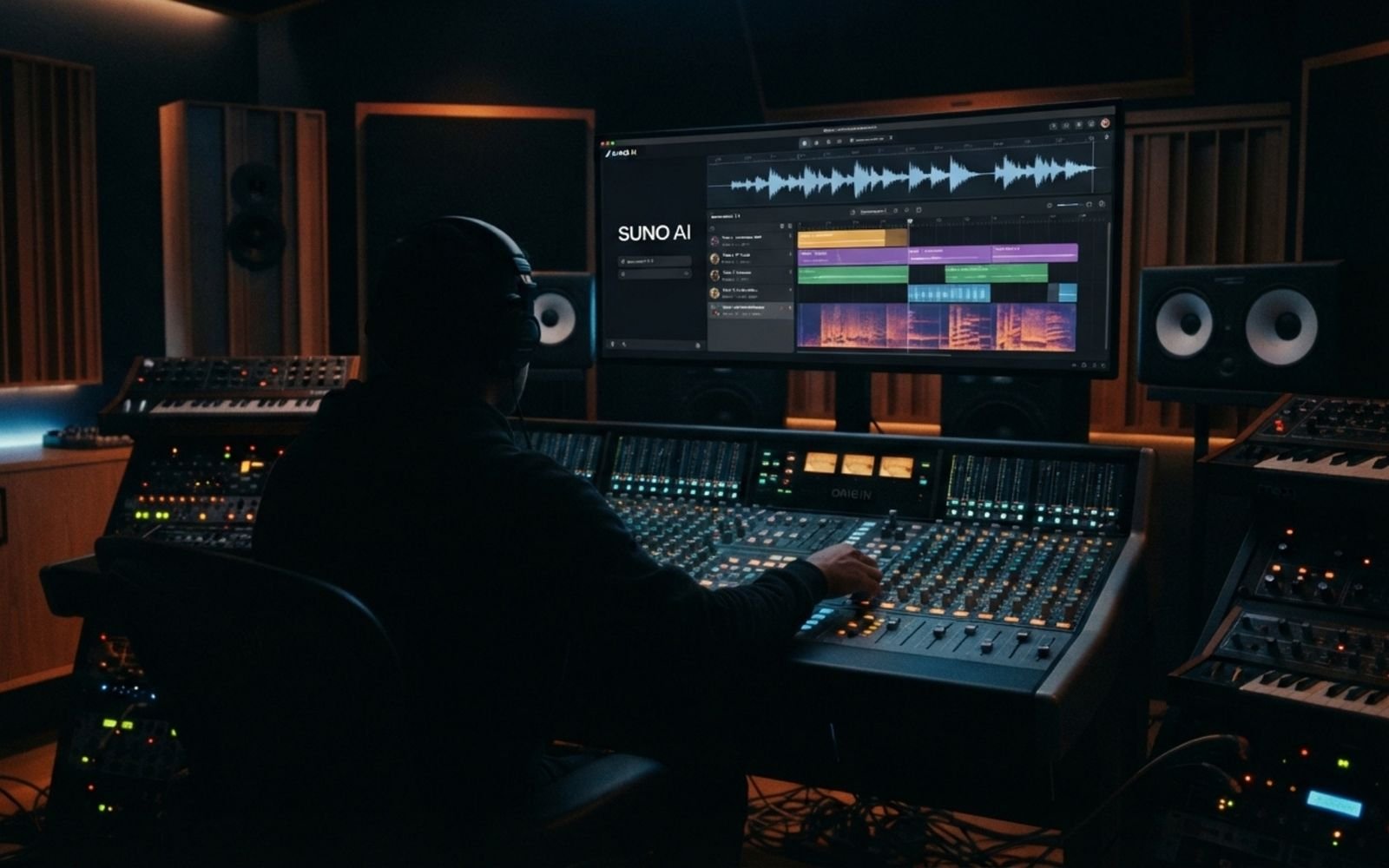
Step inside a high-end electronic production suite in Berlin’s Kreuzberg, London’s Shoreditch, Amsterdam Noord, or Istanbul’s Bebek waterfront at three in the morning, and you will witness a fascinating reality: the world’s most respected club producers are opening Suno and Udio on their second monitors almost every single night.
Yet here is the crucial distinction that separates these elite tastemakers from amateur prompt farmers: not a single millisecond of raw AI-generated audio ever touches their final master bus.
To an international touring selector, treating an AI platform as a "finished track generator" is an aesthetic and commercial dead end. The audio is smeared, the low frequencies collapse on club sound systems, and the legal ownership is non-existent. Instead, top-tier producers treat these generative engines as an infinite, ego-free sketchpad—a high-speed brainstorming partner capable of throwing twenty vocal cadences, polyrhythmic syncopations, and unexpected chord modulations at them in under sixty seconds.
They commit what sounds like the perfect crime: they harvest the lightning-fast ideation sparks of generative neural networks, extract the underlying musical DNA, and systematically erase every synthetic trace before replacing it with real analog synthesis and live human breath.
The result? A 100% copyrightable, pristine club record that sails through DSP ingestion filters, earns top-tier sync placements, and crushes festival stages—all while saving hundreds of hours of creative block in the studio.
2. The Legal Wall: Why Raw AI Audio Belongs to No One
Before integrating any generative audio tool into your studio workflow, you must strip away the corporate marketing and understand the brutal intellectual property landscape of 2026. The most dangerous assumption in modern production is believing that paying a $30 monthly subscription to an AI platform grants you ownership of the resulting music.
It does not.
The US Copyright Office’s Uncompromising Standard
In January 2025, the US Copyright Office officially released Part 2 of its comprehensive Report on Copyright and Artificial Intelligence, reaffirming its historic March 2023 guidance and solidifying statutory precedent through federal court rulings like Thaler v. Perlmutter. The office’s mandate remains absolute: copyright law exclusively protects human creative authorship.
Under current international legal frameworks: * Prompts Do Not Equal Authorship: Typing text descriptions—no matter how poetic, detailed, or technically specific—is legally classified as providing creative direction or inspiration, not executing authorship. The machine, not the prompter, determines the expressive sonic output. * Selection and Curation Are Insufficient: Rolling the dice fifty times on Udio and choosing the best iteration does not satisfy the legal threshold of human expression required to secure a registered sound recording copyright. * Minor DAW Processing Changes Nothing: Slapping an equalizer, a compressor, or an analog tape saturator over a raw AI bounce does not magically inject sufficient human authorship into the master.
If you drop an unedited AI-generated synth lead or vocal chorus into your song and upload it, you do not own exclusive rights to that audio. If a television production company, a commercial brand, or another DJ rips that exact stem from your track tomorrow, you have zero standing in federal court to sue them for master copyright infringement. You cannot register the recording with the Copyright Office without committing fraud by omission, which renders any future legal action completely toothless.
The Latent Infringement Minefield
Compounding the ownership deficit is the ongoing legal war between generative startups and the music industry. In June 2024, the Recording Industry Association of America (RIAA)—representing Universal Music Group (UMG), Sony Music Entertainment, and Warner Records—filed landmark federal lawsuits against Suno and Udio, alleging industrial-scale copyright infringement.
In court filings, Suno openly acknowledged training its models on vast libraries of copyrighted recordings scraped directly from open web sources, invoking a broad "fair use" defense. While corporate licensing agreements and settlements began reshaping the industry in 2025 and 2026, the underlying reality remains unchanged: any raw audio rendered by an unvetted diffusion model carries latent training-data contamination. When you route a raw AI bounce to your master bus, you are baking someone else's uncredited intellectual property directly into your record.
3. The Sync Licensing Nightmare: Why Hollywood and E&O Insurers Ban Raw AI
The danger of utilizing raw AI audio extends far beyond digital streaming royalties. Its most severe financial penalty occurs in the world of high-value synchronization licensing.
As we explored in our deep-dive on the unspoken rules of pitching to Netflix, HBO, and ESPN, landing a prime sync placement on prestige television can pay anywhere from $15,000 to $60,000 upfront, accompanied by tens of thousands in ongoing performance royalties. However, the gatekeepers of the sync industry operate under hyper-conservative legal protocols.
The Paperwork Wall: Representations, Warranties, and E&O Insurance
When a music supervisor selects a club record for an HBO drama or a Nike commercial, their legal affairs department requires the artist or label to sign an ironclad Master and Sync License Agreement. Within that agreement sit the Representations and Warranties (R&Rs): 1. You warrant that 100% of the musical composition and sound recording is completely original to you and your credited human collaborators. 2. You warrant that no element of the recording infringes upon the intellectual property, privacy, or statutory rights of any third party. 3. You agree to fully indemnify the studio, network, and brand against all future legal damages, legal fees, and liabilities if that warranty fails.
If your track contains an undeclared, raw AI vocal stem or algorithmic chord loop, you cannot legally sign that document. A software platform's Terms of Service is a commercial software license, not a clean copyright chain of title.
Furthermore, film and television productions require multi-million-dollar Errors & Omissions (E&O) insurance policies before broadcasting a project. In 2026, insurance underwriters mandate explicit AI disclosure riders. If a studio discovers that an indie artist delivered a track with unverified synthetic stems, the production’s E&O coverage for that cue is voided. The studio will instantly drop the track from the edit, blacklist the producer, and file an immediate breach-of-contract claim to recover expenses.
To sell your music to Hollywood, your chain of title must be immaculate. Raw AI audio fails that test every single time.
4. The Acoustic and Algorithmic Trap: Why Raw AI Audio Fails on Sound Systems
Even if the legal system vanished tomorrow, professional electronic producers still would not put raw generative audio in their arrangements. The simple truth is that raw AI audio sounds fundamentally terrible when played at 110 decibels through a high-end club sound system.
Generative diffusion models like Suno and Udio work by estimating spectrogram representations of sound and reconstructing them into audio files using lossy neural vocoders. While this process sounds surprisingly coherent through tiny iPhone speakers or budget Bluetooth earbuds, it disintegrates entirely under professional acoustic scrutiny.
1. Collapsed Low-End Phase Coherence
Electronic dance music—especially Afro House, Organic House, and Melodic Techno—relies heavily on a clinical, locked-down relationship between the sub-bass (30 Hz–90 Hz) and the kick drum transient. Neural audio engines have zero physical understanding of acoustic phase relationships. Their low-end outputs are riddled with micro-phase cancellations and blurred transients. Play an unedited AI bassline through a Void Acoustics or Funktion-One system at Scorpios Mykonos or Club Space Miami, and the dancefloor will feel hollow, muddy, and weak.
2. Upper-Frequency Neural Smearing and Artifacts
In the high-frequency spectrum (12 kHz–18 kHz), raw generative audio leaves behind unmistakable acoustic artifacts: a brittle, metallic, "underwater" fizz caused by neural codec compression. Transient-heavy elements like shaker loops, hi-hats, and vocal sibilants suffer from temporal smearing, robbing the groove of its organic swing and punch.
3. Ingestion Scanners and Algorithmic Quarantine
As detailed in our investigation into Spotify's DDEX AI policies and Deezer's detection technology, streaming platforms have deployed acoustic forensics that analyze these exact upper-frequency phase anomalies and neural footprints with over 99% accuracy.
When you upload a master containing raw AI stems without DDEX disclosure, DSP ingestion pipelines flag your track as synthetic spam. You are not served a dramatic takedown notice; instead, you are placed in silent Algorithmic Quarantine, cut off from Release Radar, Discover Weekly, and editorial consideration.
| Dimension | Raw Generative Audio (Suno / Udio) | Re-Created Human Master (The Protocol) |
|---|---|---|
| US Copyright Protection | None. Lacks human authorship; unregistrable under USCO standards. | 100% Protected. Full master and publishing rights legally secured. |
| DSP Ingestion Status | High risk of DDEX flag or silent recommendation suppression. | Clean delivery; zero algorithmic friction or synthetic spam tags. |
| Club Sound System Response | Smeared transients, muddy low-end phase cancellations, metallic highs. | Pristine dynamic range, phase-coherent 30 Hz sub, punchy transients. |
| Sync Licensing Eligibility | Disqualified by studio legal teams and media E&O insurance underwriters. | Fully clearable; qualifies for major TV, film, and commercial placements. |
| Artistic Authenticity | Generic, disposable, and easily mimicked by prompt competitors. | Distinctive personal sonic signature, emotional depth, and live story. |
5. The 3-Step "Human Re-Creation" Protocol
How do A-list producers bridge this divide? How do they capture the lightning speed and creative unpredictability of generative AI while delivering an uncompromised, 100% human-performed, fully copyrightable club master?
They follow a strict, disciplined three-step methodology known across top studios as the Human Re-Creation Protocol.
[Phase 1: Seed]      Your Original Chords / Hummed Voice Memo ---> Loaded into AI Model
                             │
[Phase 2: Extract]   Generate Ideas ---> Separate Stems ---> Convert Audio to MIDI
                             │
[Phase 3: Humanize]  Route MIDI to Real Synths + Hire Human Session Singer ---> Pristine Master
Phase 1: Audio-to-Audio Seeding (Injecting Your Own DNA)
The amateur mistake begins with the text prompt. When you type "melodic afro house track with emotional vocal and warm chords," you are asking a neural model to sample average internet data, yielding generic musical wallpaper.
Elite producers bypass text generation entirely. Instead, they use Audio-to-Audio (Audio Input) workflows:
- Establish the Human Foundation: Open your DAW (Ableton Live, Logic Pro, or FL Studio) and compose a simple 8-bar musical skeleton. It could be a lush minor-ninth chord progression played on a Rhodes, an authentic acoustic guitar strum, or a rough vocal melody hummed directly into your smartphone voice memo.
- Seed the Model: Upload your original 30-to-60 second audio snippet into Suno or Udio.
- Use Prompts Strictly for Directional Friction: Instead of asking the tool to compose a song, prompt it to act as an arranger or improviser around your seed: "hypnotic West African call-and-response vocal phrasing, polyrhythmic marimba counter-melody, 122 BPM, minor key."
Because the generation is anchored to your original harmonic seed, the AI acts as a reactive jam partner rather than a replacement composer.
Phase 2: Forensic Deconstruction and MIDI Extraction
Once the engine renders an iteration containing an extraordinary hook—perhaps a syncopated bassline movement or a vocal cadence that makes the hairs on your arms stand up—your immediate priority is to destroy the audio file.
You do not keep the stem. You do not tuck it into the background of your mix. You treat the audio purely as an architectural blueprint.
Step A: Isolate Motif with Stem Splitter (RipX DAW / Serato Sample / iZotope RX)
Step B: Extract Melodic Notes via Audio-to-MIDI (Melodyne / Ableton / Basic Pitch)
Step C: Quantize Manually, Add Groove Swing, Delete Original Audio Waveform
Step D: Re-Synthesize Notes via Hardware (Moog / Prophet) or Elite Analog VSTs (Diva)
- Stem Isolation: Run the generation through an elite separation tool like RipX DAW PRO, Serato Sample, or iZotope RX to cleanly isolate the melodic hook away from the background noise.
- Audio-to-MIDI Conversion: Bring the isolated stem into your DAW. Use Ableton Live’s Convert Melody/Harmony to MIDI, Celemony Melodyne, or Spotify’s open-source Basic Pitch algorithm to translate the transient frequencies into precise MIDI notes.
- Human Timing and Velocity Editing: Raw MIDI extracted from AI audio is notoriously messy. Zoom into your piano roll. Adjust overlapping note ends, correct ghost notes, and deliberately humanize the micro-timings. If you are building an Afro House record, apply a classic Akai MPC swing or hand-nudge your percussion hits slightly behind the beat to create that hypnotic, human pocket.
- Analog and Hybrid Re-Synthesis: Route that pristine MIDI into real analog hardware or premier modeling synthesizers. Fire up a Sequential Prophet-6 for lush polyphonic pads, a Moog Sub 37 for an authoritative low-end bass drive, or high-end virtual instruments like u-he Diva, Arturia V Collection, or Spectrasonics Omnisphere.
The melodic idea remains, but the synthetic audio waveform has ceased to exist. In its place sits an ultra-high-resolution, phase-coherent sound recording performed directly inside your session.
Phase 3: The Human Vocalist Translation (The Ultimate Upgrade)
Nowhere is the line between amateur and master more stark than in the treatment of vocals. A club record lives and dies by the soul, grit, and emotional vulnerability of the human voice. An unedited synthetic vocal will always feel hollow—and it instantly alerts DSP audio scanners.
Elite producers treat AI-generated vocal hooks strictly as scratch vocal demos and topline guides.
[AI Topline Scratch Demo] ---> [Lyric Transcription & Polish] ---> [Live Studio Session]
                                                                          │
                                                               ┌──────────┴──────────┐
                                                               ▼                     ▼
                                                        Neve 1073 Preamp       Neumann U87 Mic
                                                               │                     │
                                                               └──────────┬──────────┘
                                                                          ▼
                                                                [100% Human Master]
- Decode and Refine the Lyrics: Generative audio models frequently produce convincing melodic phrases wrapped in phonetic gibberish or nonsensical English. Transcribe the rhythmic cadence and replace placeholder words with meaningful, poetic lyrics. If you are producing Afro House or Organic House, collaborate with native speakers to translate the concepts into authentic Swahili, Zulu, Yoruba, or Portuguese.
- Book Real Session Talent: Head to professional artist platforms like SoundBetter, Vocalizr, or reach out directly to independent vocalists via Instagram or TikTok. Send them the backing track alongside the extracted vocal guide, clearly explaining the phrasing, dynamic accents, and emotional tone you want captured.
- Capture True Studio Provenance: Have the vocalist track multiple takes through a classic studio chain—such as a Neumann U87, Sony C800G, or Shure SM7B routed into a Neve 1073 preamp and Tube-Tech CL 1B compressor.
When those multi-track vocal stems arrive back in your DAW, you possess real human chest resonance, natural room acoustics, subtle breathing dynamics, and genuine vocal imperfections that cannot be synthesized. More importantly: you own a 100% human-authored master recording supported by signed split sheets and work-for-hire agreements.
As we documented in the story of Sofiya Nzau and the global phenomenon 'Mwaki', the entire global music economy is built on real human cultural lineage. Re-recording your hooks with real vocalists honors that culture while granting your catalog bulletproof commercial value.
6. The Producer’s Rules of Engagement: A 7-Step Protocol Checklist
Before opening your DAW for your next late-night session, commit this operational checklist to memory. Tape it beside your audio monitors:
- [ ] 1. Commercial Subscription Verification: Always operate under an active, paid tier on any AI platform you use for ideation to maintain clear contractual rights according to the vendor's terms.
- [ ] 2. Human-Seeded Inputs Only: Never begin with blank text prompts. Always seed generative models with your own recorded chords, acoustic instrument loops, or vocal voice memos.
- [ ] 3. Strict Stem Isolation & MIDI Bouncing: The moment an interesting motif emerges, isolate it, convert it to MIDI data, and permanently delete the raw
.wavor.mp3bounce from your hard drive. - [ ] 4. Analog or High-End VST Re-Synthesis: Route all extracted MIDI through authentic analog synthesizers or industry-standard virtual instruments with full dynamic range and zero neural artifacts.
- [ ] 5. Live Session Vocalist Execution: Never leave synthetic voices in a commercial release. Treat AI singing strictly as a scratch demo and hire a professional human singer to re-record every line.
- [ ] 6. Archive Your Studio Session Paper Trail: Preserve your original DAW project file (
.als,.flp, or.logicx), raw multi-take vocal folders, and timestamped bounce histories to prove human creation during label A&R audits or sync clearances. - [ ] 7. Immaculate Split Sheets & Contracts: Execute signed Work-for-Hire agreements and Songwriter Split Sheets with every human instrumentalist and vocalist involved in your release.
7. What This Means for Electronic Music in 2027: The Curator-Architect
As we look toward 2027, the role of the electronic music producer is undergoing its most radical transformation since the invention of the MIDI sequencer in the 1980s.
For decades, producers spent thousands of cumulative hours performing mechanical studio labor: manually nudging audio transients, tuning off-pitch vocal takes note by note, and endlessly scrolling through sample packs searching for a complementary kick drum. Today, generative algorithms can perform low-level pattern generation in seconds.
This does not make the producer obsolete; it elevates their responsibility.
The future belongs to the Curator-Architect. The bedroom producer who relies on AI to make creative choices for them will be permanently relegated to the bottom of the streaming pool—producing disposable background filler that is algorithmically muted, demonetized by DSP spam rules, and ignored by real club crowds.
Conversely, the artist who views AI as a high-velocity mirror—using it to test ideas rapidly, challenge their own musical habits, and fuel human performance—will operate with unprecedented speed and creative power. They can conceptualize three entire album directions over a single weekend, discard seventy mediocre concepts without emotional attachment, and commit their studio budget exclusively to the ideas that possess undeniable cultural resonance.
When you submit a demo to an elite label like Soir Records, our A&R team does not evaluate how many hours you spent drawing automation curves. We evaluate whether the groove has a distinct heartbeat, whether the sonic balance commands a soundsystem, and whether the emotional frequency connects with a crowd at 4 AM (as we discuss in The 7-Second Massacre: A&R Review Psychology).
Generative tools can give you an idea. Only human taste, analog craft, and authentic cultural collaboration can turn that idea into a record that echoes through history.
Key Takeaways
- Raw AI Audio Is a Legal Dead End: Under US Copyright Office guidance and federal case law (Thaler v. Perlmutter), pure generative audio lacks human authorship and cannot be protected by copyright, leaving your music vulnerable to unpunished commercial theft.
- Sync Licensing Requires Clean Paperwork: Major networks like Netflix and HBO, alongside media liability E&O insurers, require ironclad warranties of human originality. Using raw AI stems can void insurance policies and trigger severe indemnification claims.
- Sound Systems Expose Synthetic Flaws: Neural diffusion models suffer from low-end phase cancellations, smeared transients, and brittle high-frequency vocoder artifacts that sound hollow and muddy through professional club speaker stacks.
- The Re-Creation Protocol Solves the Paradox: By seeding models with human audio, isolating motifs into clean MIDI data, and re-synthesizing sounds on real instruments, producers capture AI ideation speed while retaining 100% copyright ownership.
- Always Hire Real Vocalists: Never release synthetic vocals. Treating AI vocal generations as scratch demo guides and paying human session vocalists to re-sing the parts guarantees pristine acoustics, authentic emotion, and defensible ownership.
Frequently Asked Questions (FAQ)
Can I legally copyright a song if I used Suno or Udio to create the initial melody?
Yes, provided that you utilize the generative output strictly as an ideation sketch and re-record the melody yourself. Under US Copyright Office standards, while purely machine-generated audio files cannot be copyrighted, a musical composition and master recording performed, arranged, and recorded by human musicians—even if inspired by an AI-generated sketch—is fully protected under human authorship law.
Will using Suno or Udio to sketch vocal melodies trigger Spotify's AI detection filters?
Not if you follow the Human Re-Creation Protocol. Streaming platforms like Spotify and Deezer utilize neural audio detectors that analyze specific phase anomalies, metallic codec artifacts, and synthetic vocal footprints embedded in raw audio files. When you transcribe the vocal melody to MIDI, write your own lyrics, and hire a human session singer to record through real microphones, no synthetic audio ever reaches the master file, completely bypassing algorithmic filters.
If I subscribe to Suno Pro or Udio Premier, don't I own the audio commercially?
You own a commercial license from the software vendor to monetize the output, but you do not hold a recognized exclusive copyright over the master sound recording under US and international intellectual property law. A company's Terms of Service cannot override statutory copyright requirements for human authorship. Anyone can legally sample or rip your raw AI audio without your legal ability to sue for copyright infringement.
What tools are best for extracting MIDI from an AI-generated audio sketch?
The most reliable tools for converting melodic and harmonic audio sketches into usable MIDI data are Celemony Melodyne (industry standard for monophonic and polyphonic pitch detection), RipX DAW PRO (exceptional for surgical stem separation and note editing), Ableton Live's native 'Convert Melody to MIDI' function, and Spotify's open-source Basic Pitch machine-learning algorithm.